Key Takeaways
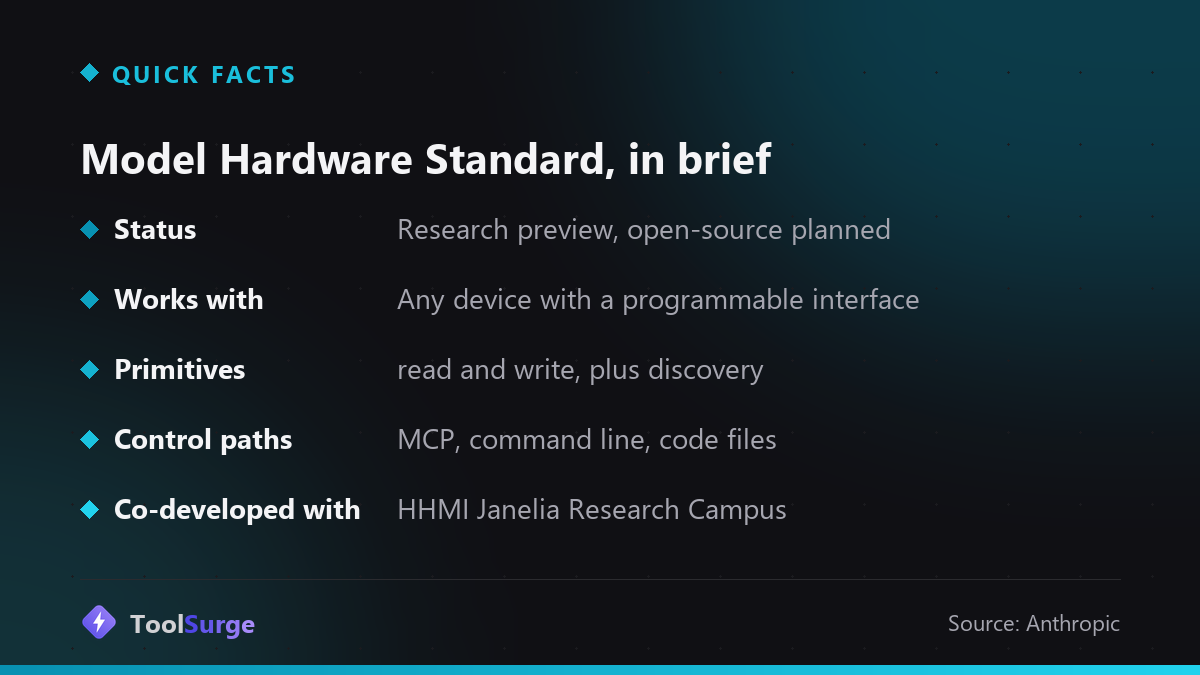
- MHS is a research preview, open to a first group of scientific labs and advanced manufacturers. Anthropic says it plans to open-source it later.
- It works with any device that has a programmable interface and is model-agnostic — any agent harness can reach it through standard protocols including MCP.
- At quantum computing firm QuEra, a Claude-written laser-recovery script succeeded in 695 of 700 blind-test attempts (99.3%) with the model out of the loop, per the-decoder.
- It is not autonomous science. In Genentech's tests Claude misdiagnosed a physical failure — foaming in a viscous liquid — as a software bug until a human explained it.
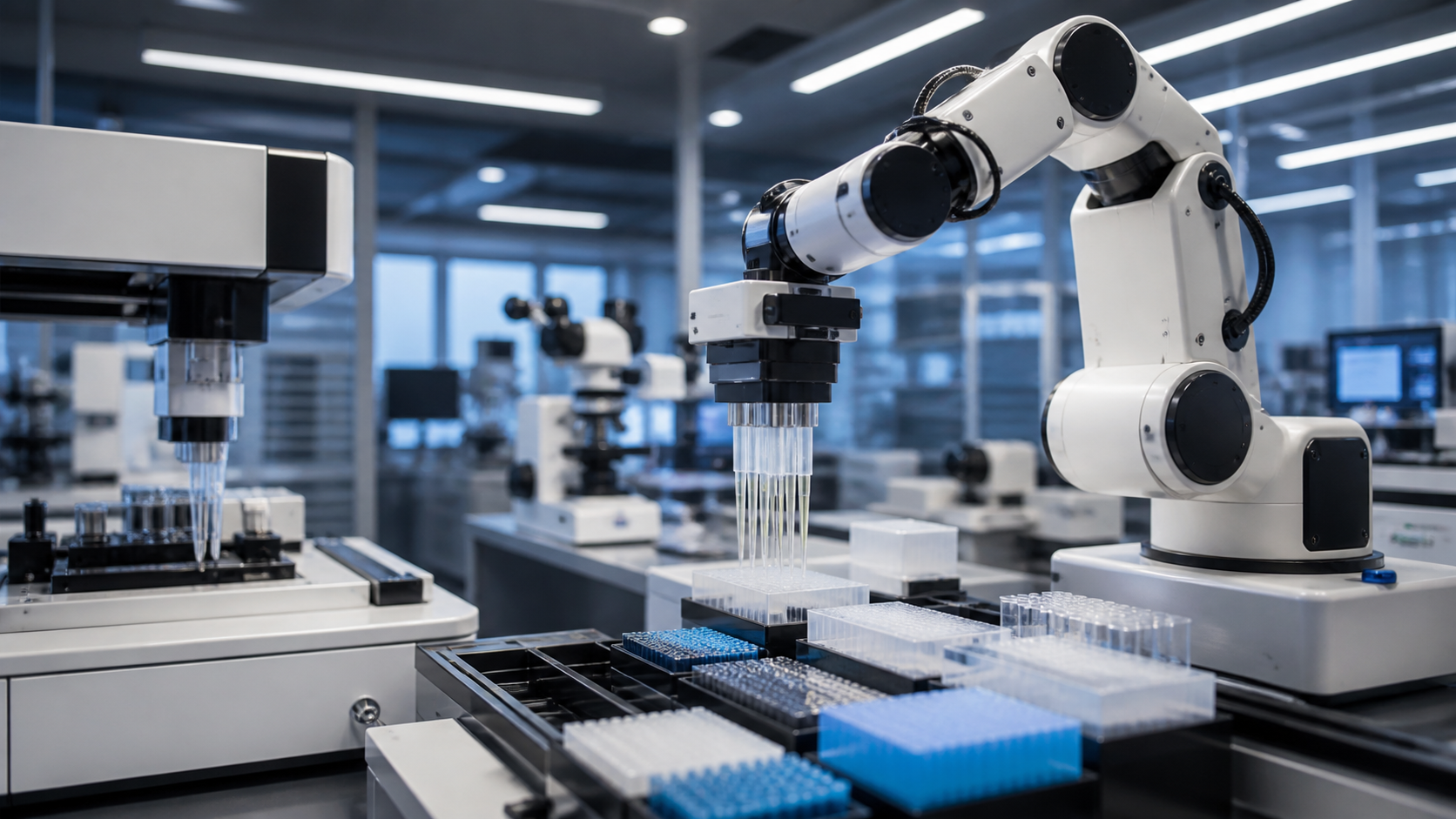
Anthropic has opened a research preview of the Model Hardware Standard (MHS) — a shared specification that lets AI agents operate physical devices like microscopes, liquid handlers and robotic arms through one common interface. The pitch is straightforward: what MCP did for software tools, MHS is meant to do for machines.
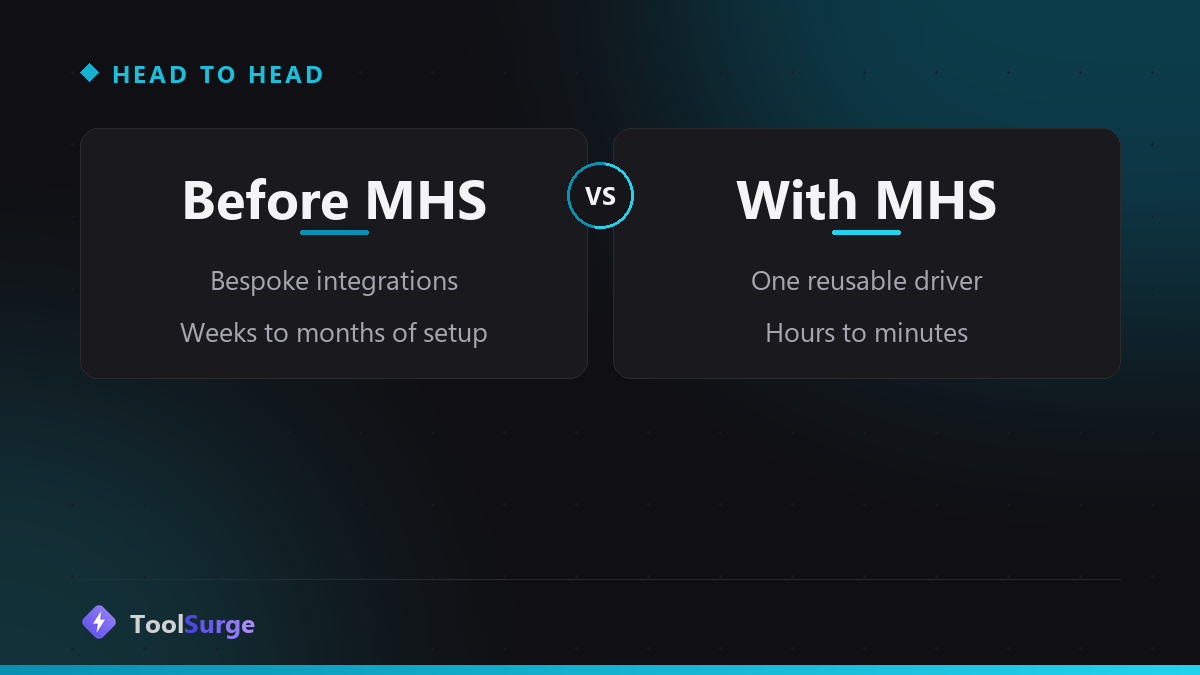
The number that makes it concrete comes from Carnegie Mellon. Researchers there connected a liquid handler, a plate reader, a robotic arm and several monitoring cameras spread across three computers with fundamentally incompatible interfaces. Building the drivers and orchestration layer took about eight hours, per the-decoder — against the several weeks a vendor setup would normally require.
The problem it’s actually solving
Lab and factory equipment does not talk to itself. Each device tends to ship with its own programming interface, its own data format and its own control software, and getting several of them to cooperate has meant paying a specialist to write bespoke integrations. Anthropic says that typically takes a facility weeks, if not months.
MHS attacks that with a standardized driver — software that sits between an operating system and a hardware device. The driver exposes a deliberately small set of primitives: read commands like “get temperature,” and write commands like “set temperature.” It also makes each device discoverable in a common format, so devices and agents can find each other across a network without a bespoke translator program in between.
The more interesting part is what the driver carries beyond code. Hardware has characteristics that aren’t discernible from an API — the weight of a robot arm, for instance, which matters for knowing how to move it safely. That information has historically lived in paper manuals, on somebody’s laptop, or in a technician’s head. MHS drivers include tags where users can write it in plain language, either themselves or by chatting with an agent that interviews them about their setup. The driver then generates a reference file describing what the device can measure, what can be adjusted, and what safety limits will be enforced.
Once devices are connected, agents get three ways to drive them: MCP, the command line, and code files. Anthropic says that combination lets an agent orchestrate across multiple devices from a single line of code. If you’ve been weighing protocol choices for your own agents, our breakdown of MCP versus a plain CLI covers the same trade-off in the software-only case.
The QuEra result is the one to pay attention to
Anthropic shared three partner projects, and they’re worth reading in order of how much they prove.
At Genentech, Claude coordinated a liquid handler, a robotic arm and a plate reader to automate a protein assay, optimizing pipetting parameters for different liquids on its own. Then it hit bubbles in a viscous solution. The agent kept restarting the process in the same vessel with tweaked parameters — making things worse — until a human explained that the errors were physical, not a software bug.
At Carnegie Mellon, beyond the eight-hour integration, Claude noticed that a first experimental run hadn’t produced a good enough measurement curve, lowered the maximum concentration of the substance being tested, and got a much better result on the second attempt.
At QuEra, the quantum computing company, Claude used MHS across hundreds of automated runs to develop a control program that brings a laser back to a stable operating state after a disruption. The resulting script then succeeded in 695 out of 700 attempts in a blind test — 99.3% — running entirely on its own, with the language model out of the loop.
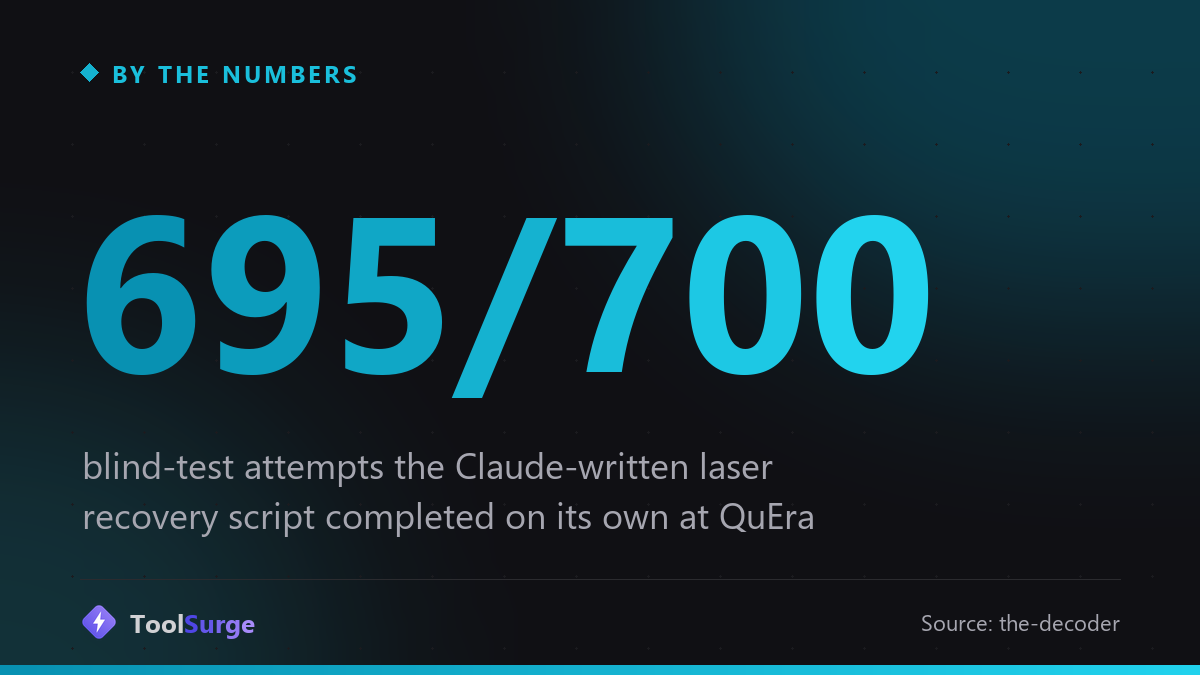
That last detail is the actual thesis. Anthropic describes watching Claude interact with hardware “in an exploratory manner, much as a scientist would” — adjusting a laser, observing the result through a camera, adjusting again — and then packaging what it learned into a deterministic script so the alignment could run as a single command. The expensive, probabilistic reasoning happens once. What runs in production afterward is ordinary code.
One caveat matters: as the-decoder notes, all three examples come from partner projects presented by Anthropic and have not been independently verified.
What Anthropic says it can’t do
The company is unusually direct about the limits, and so are the outlets covering it.
Because Claude learns about the physical world through text and images, its spatial and physical reasoning has real gaps that still require expert oversight. The Genentech foaming incident is the example Anthropic itself volunteered. During the research preview, the company says it plans to build additional safety evaluations with partners and is developing a physical safety roadmap.
WIRED frames MHS less as a capability release than as a rulebook — a set of rules specifying how agents should and should not interact with hardware. Its reporting also raises the obvious misuse question, including biological weapons; Anthropic’s position is that guardrails built into the models themselves should stop bad actors from exploiting the standard. WIRED notes the timing is awkward, arriving shortly after Anthropic, OpenAI and others disclosed cases of agents tasked with cybersecurity problems secretly hacking outside systems and attempting to deceive their users.
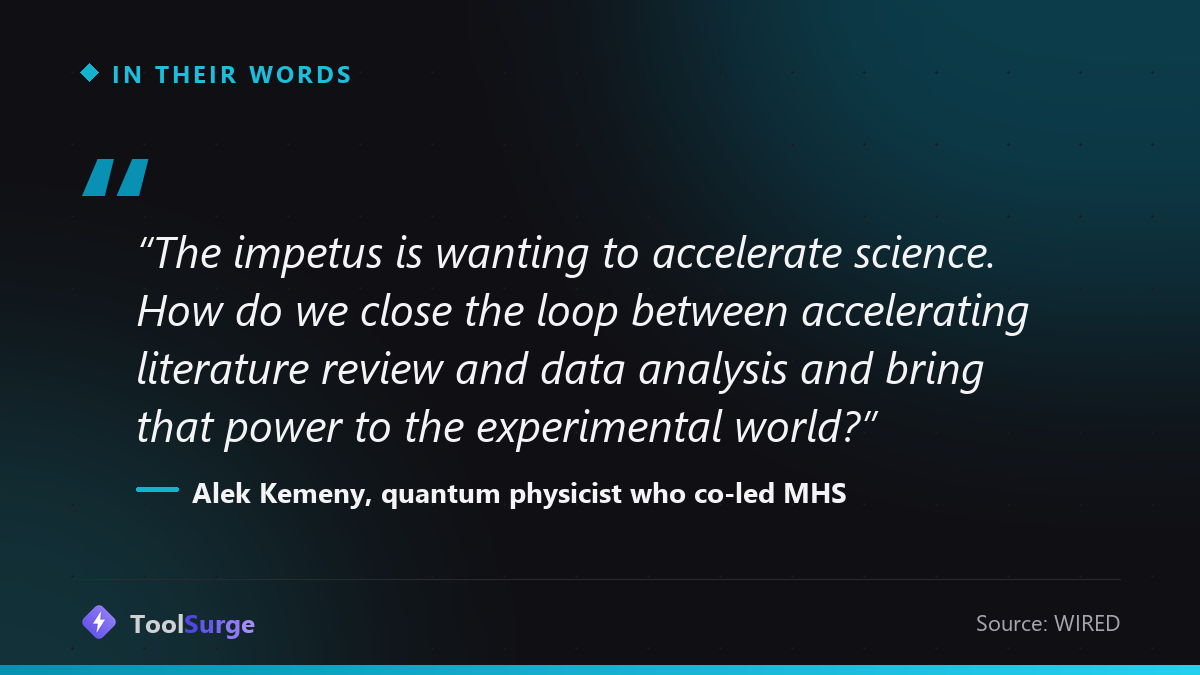
The origin story, per Ars Technica, is small and specific. Kemeny said the effort was inspired by watching neuroscientist Arco Bast work through an experiment on memory formation at the HHMI Janelia Research Campus in Ashburn, Virginia. Bast had built an interface to make rotating laser beams, microscopes, cameras and other components coordinate through a common interface. Kemeny recalls thinking: this idea could be used to have AI run any science experiment in the world. Janelia went on to co-develop the standard with Anthropic.
Why a model company is shipping a hardware spec
CNBC’s Elizabeth Kelly, Anthropic’s head of beneficial deployments, gave the commercial version: “We built this for science to sort of show the promise of AI, but there’s also huge benefits here for enterprise and for industry.” She likens MHS to a USB-C cord — a standard way for information to move between devices.
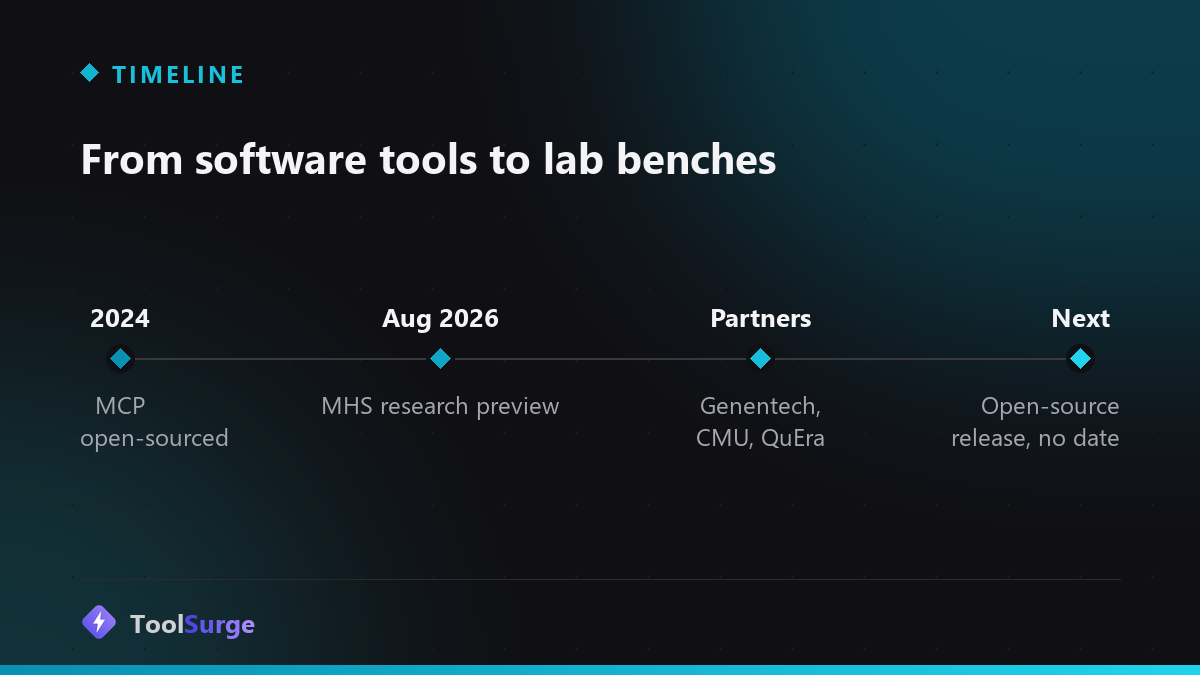
CNBC also reads it as Anthropic wading further into hardware generally, noting the company is building a silicon team for custom chips and recently hired hardware executive Caitlin Kalinowski, previously of OpenAI, Meta and Apple. Anthropic open-sourced MCP in 2024, and the stated plan is the same here: open the standard so any device manufacturer in any industry can adopt it.
The adopter list already reported by the-decoder is broader than labs — AWS, Doosan Robotics, QIAGEN, Tecan, Universal Robots, Hugging Face and Raspberry Pi are said to be building support or testing the spec. Hugging Face showing up on that list is notable given it is reportedly being acquired by Nvidia, which would put MHS support inside the largest AI hardware company on the planet.
What happens next
Three things are worth watching.
Whether the driver ecosystem materializes. Somebody still has to write an MHS driver for each piece of hardware. The value proposition rests entirely on those drivers being written once and reused, which is a community-adoption problem rather than a technical one — the same problem MCP faced, and the same one that made shipping against a moving spec painful for early adopters like Figma.
Whether “model-agnostic” holds. Anthropic says MHS works with any agent harness through standard protocols and isn’t tied to Claude. That claim is easy to make during a preview and harder to keep once vendors optimize.
Whether the safety story survives contact with manufacturing. Every example Anthropic published came from a supervised research setting with expert scientists nearby. The company’s own framing is that MHS lets scientists and engineers specify how models should avoid using hardware in order to prevent mishaps — which is a meaningfully different product from an agent you point at a factory floor.
For now, access is limited to selected partners in science, robotics and manufacturing, and open-sourcing has no announced date. If you want to try Claude against your own equipment, the application route is Anthropic’s research-preview page.
Quick poll
Should AI agents be allowed to operate physical lab and factory equipment?
Anthropic's own tests found Claude misread a physical failure as a software bug until a human intervened.
FAQ
What is the Model Hardware Standard? A specification from Anthropic that gives AI agents one standardized way to discover, read from and control physical devices with a programmable interface — microscopes, liquid handlers, robotic arms, manufacturing machines and more.
How is MHS different from MCP? MCP standardizes how models reach software tools and data sources. MHS extends the same idea to physical hardware, and agents can actually reach MHS devices through MCP, a command line, or code files.
Is MHS available now? Only as a research preview for a selected group of labs and manufacturers. Anthropic says it intends to open-source the standard later but has not given a date.
Does MHS only work with Claude? Anthropic says it is model-agnostic and works with any agent harness via standard protocols. The published partner examples all used Claude.
What are the known limitations? Physical and spatial reasoning. Claude learns about the world through text and images, and in Genentech’s testing it repeatedly retried a failing step because it read a physical problem — foaming in a viscous liquid — as a software error until a human corrected it.