Key Takeaways
- GitHub says Gemini 3.1 Pro, four Claude 4.x models, and Raptor Mini will be deprecated across Copilot experiences on September 1, 2026.
- Annual individual subscribers are the stated exception for Claude Sonnet 4.6; GitHub says that model will remain available to them.
- GitHub originally pointed Raptor Mini users to MAI-Code-1-Flash, but later scheduled that replacement for deprecation on September 10.
- MAI-Code-1.1-Flash is the newer small-tier model, but Business and Enterprise administrators must enable its policy before users can select it.

GitHub Copilot is scheduled to remove six models on September 1, 2026. If you have pinned a model in Chat, agent mode, inline edits, code completion, or an organizational policy, today is the day to check it. There is a second wrinkle: one replacement named in GitHub’s original migration table is itself scheduled to disappear nine days later.
This is not a reason to abandon Copilot. It is a reason to treat model names as versioned dependencies rather than permanent product features.
The six models on the September 1 list
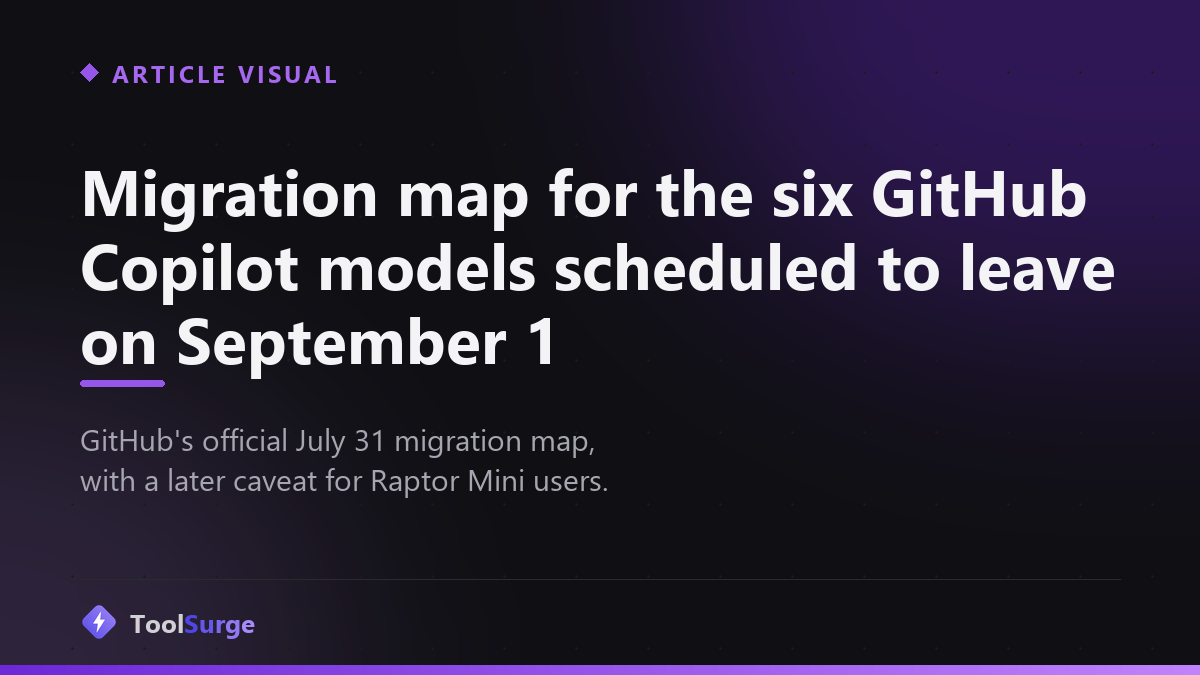
GitHub’s July 31 notice covers every Copilot surface, explicitly including Copilot Chat, inline edits, ask and agent modes, and code completions. The models and GitHub’s stated alternatives are:
- Gemini 3.1 Pro → Gemini 3.6 Flash.
- Claude Opus 4.5 → Claude Opus 4.7, 4.8, or 5.
- Claude Opus 4.6 → Claude Opus 4.7, 4.8, or 5.
- Claude Sonnet 4.5 → Claude Sonnet 5.
- Claude Sonnet 4.6 → Claude Sonnet 5.
- Raptor Mini → MAI-Code-1-Flash.
The one published exception is narrow. GitHub says Claude Sonnet 4.6 will remain available to individual Copilot subscribers on annual plans so they retain a Sonnet option. That language does not promise the same exception to monthly individual plans or organizational seats.
If your team chose Copilot because it offered several model families behind one interface, this is the trade-off that comes with that convenience. Our broader Cursor versus Claude Code versus Copilot comparison explains the product-level differences; this update is only about the model dependency inside Copilot.
The Raptor Mini path now has two steps
The original table tells Raptor Mini users to move to MAI-Code-1-Flash. Eleven days later, GitHub published another notice: MAI-Code-1-Flash will be deprecated across Copilot on September 10, with MAI-Code-1.1-Flash as its suggested replacement.
That makes a direct Raptor Mini-to-MAI-Code-1-Flash migration poor timing unless you need the older model for a very short compatibility window. GitHub has not published a revised July 31 table that directly maps Raptor Mini to 1.1. Moving straight to 1.1 is therefore our practical inference from the two official notices, not a replacement mapping GitHub stated in the original announcement.
MAI-Code-1.1-Flash adds native image understanding and, according to GitHub, improves coding quality, instruction following, tool use, and performance. GitHub also says its list price is 73% lower than MAI-Code-1-Flash and that annual Copilot subscribers are charged a 0.25× premium-request multiplier. Those details make it a plausible small-model successor, but they do not prove that it behaves identically on your repository.

Pick by workload, not by the closest name
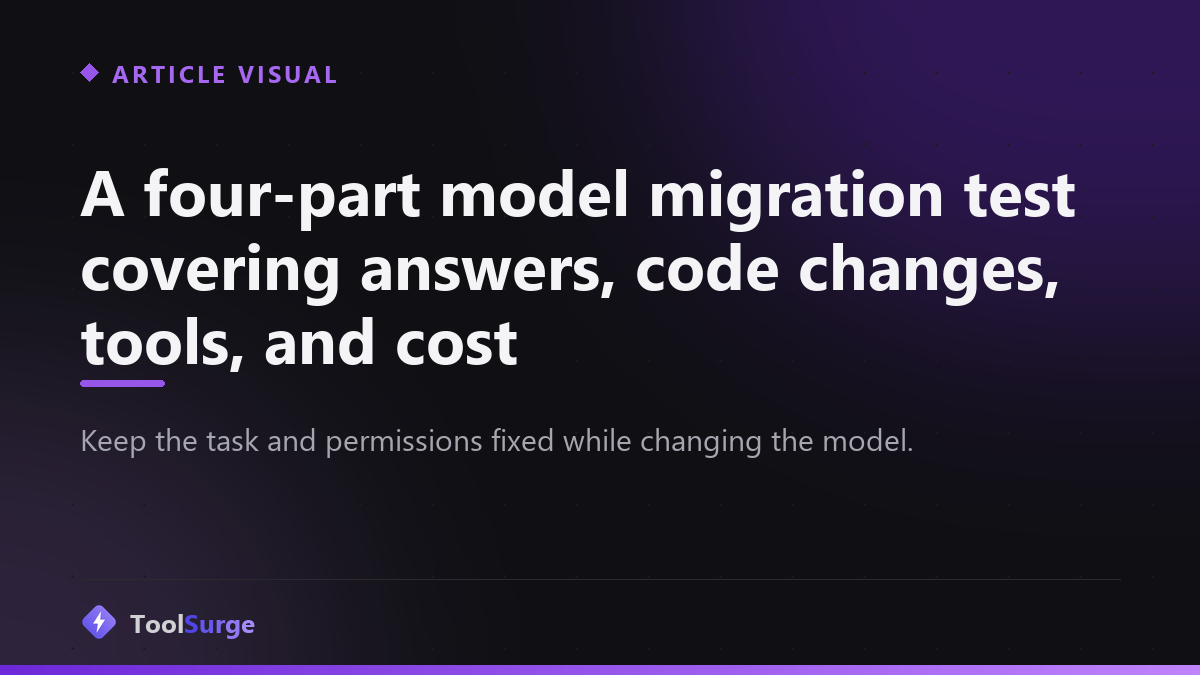
A suggested alternative is a starting point, not a compatibility guarantee. The safest migration test is the work your team already performs.
For a conversational model used mainly to explain code, assemble a fixed set of representative questions and compare factual accuracy, file references, and whether the answer admits uncertainty. For an agent, replay bounded tasks in a disposable branch and compare test results, changed-file scope, tool calls, and completion time. For inline completion, use several real editing sessions instead of one synthetic prompt.
Do not change model and workflow policy in the same test. If you migrate from Claude Sonnet 4.6 to Sonnet 5 while also granting more tools or increasing autonomy, a better result will not tell you which change helped, and a failure will not tell you which change caused it. Our guide to rolling out coding agents at work makes the same case for controlled adoption at the team level.
There is no universal winner hidden in GitHub’s replacement list. Opus may be appropriate for a difficult, long-running task while a Flash-tier model may make more sense for fast, repetitive work. What matters is whether the replacement clears your acceptance checks at a cost and latency you can live with.
Administrators have one extra failure mode
GitHub says Copilot Business and Enterprise administrators must enable the MAI-Code-1.1-Flash policy in Copilot settings; it is off by default. GitHub gave the same general warning in its September 1 notice: enterprise administrators may need to enable alternative models through model policies before users see them in the picker.
That means a migration can fail even when the replacement model exists. Check policy availability first, then confirm that a representative user can actually select the model in the surface your team uses. GitHub lists MAI-Code-1.1-Flash across Copilot CLI, cloud agent, the Copilot app, Chat on GitHub, VS Code, Visual Studio, GitHub Mobile, JetBrains IDEs, Eclipse, and Xcode, but organizational policy still gates access.
For teams, write down three things before the switch: the old model name, the approved replacement, and the owner who can change the policy. Add the test result and rollback choice after the switch. That small record is more useful than discovering next week that every developer made a different choice.
What happens next
GitHub says no action is required to remove a deprecated model; the platform will remove it. That is convenient only if your workflows do not depend on an explicit model choice. Teams with policy files, internal instructions, screenshots, training material, or evaluation fixtures should update those references themselves.
The deeper lesson is that access to many models inside one coding product does not make those models stable. Our best AI coding assistants guide compares the products as they exist now, but any model-specific recommendation needs a date beside it. For this migration, September 1 is the immediate deadline and September 10 is the follow-up.
Quick poll
How does your team handle a coding-model deprecation?
GitHub has published two Copilot deprecation dates for September 2026: September 1 and September 10.
FAQ
Which GitHub Copilot models are leaving on September 1, 2026? Gemini 3.1 Pro, Claude Opus 4.5 and 4.6, Claude Sonnet 4.5 and 4.6, and Raptor Mini, according to GitHub’s July 31 notice.
Can annual subscribers keep Claude Sonnet 4.6? GitHub says individual Copilot subscribers on annual plans are exempt from the Sonnet 4.6 deprecation. It does not state that the exception applies to other plans.
Should Raptor Mini users move to MAI-Code-1-Flash? GitHub originally suggested it, but MAI-Code-1-Flash is scheduled to leave on September 10. MAI-Code-1.1-Flash is the later official successor; test it against your workload before standardizing it.
Will GitHub remove the old models automatically? Yes. GitHub says users do not need to take action to remove deprecated models, but administrators may need to enable replacements and teams should update model-pinned workflows and documentation.