Key Takeaways
- Reported trials include Kinova robotic arms and systems from Watney Robotics and ABB.
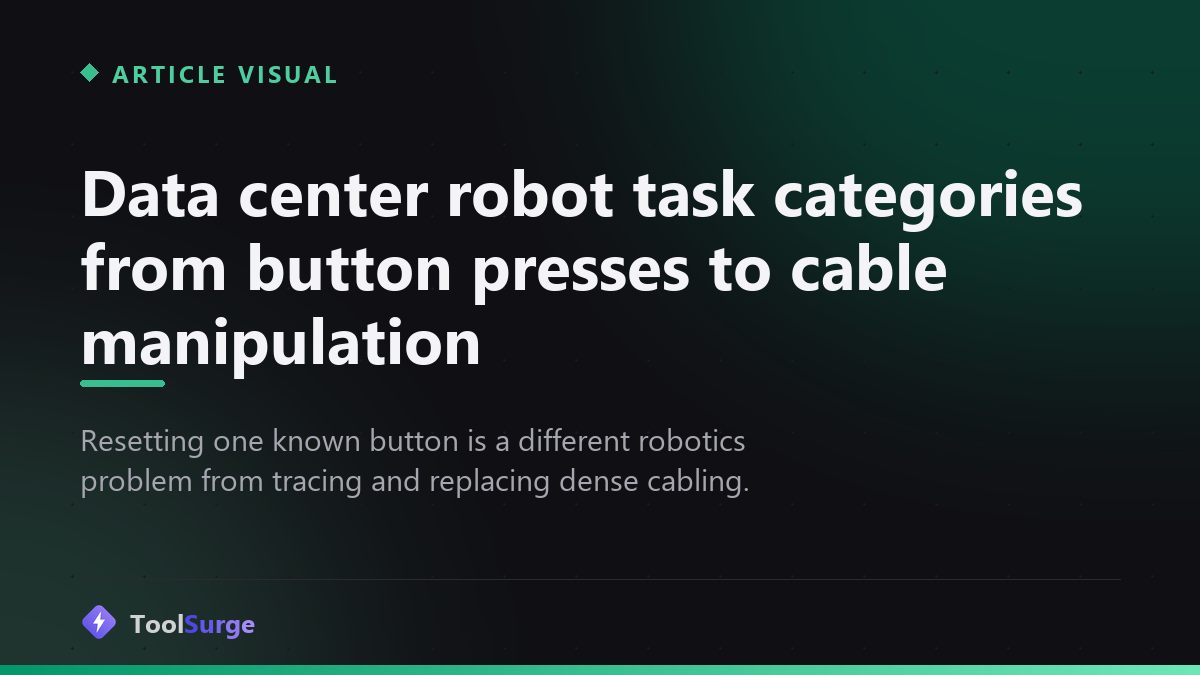
- Simple remote resets and inventory work are easier than dense cable manipulation.
- Current machines can be slower than technicians and still need supervision, charging, and help between areas.
- Meta says it is investing in hiring and training as its infrastructure footprint expands.
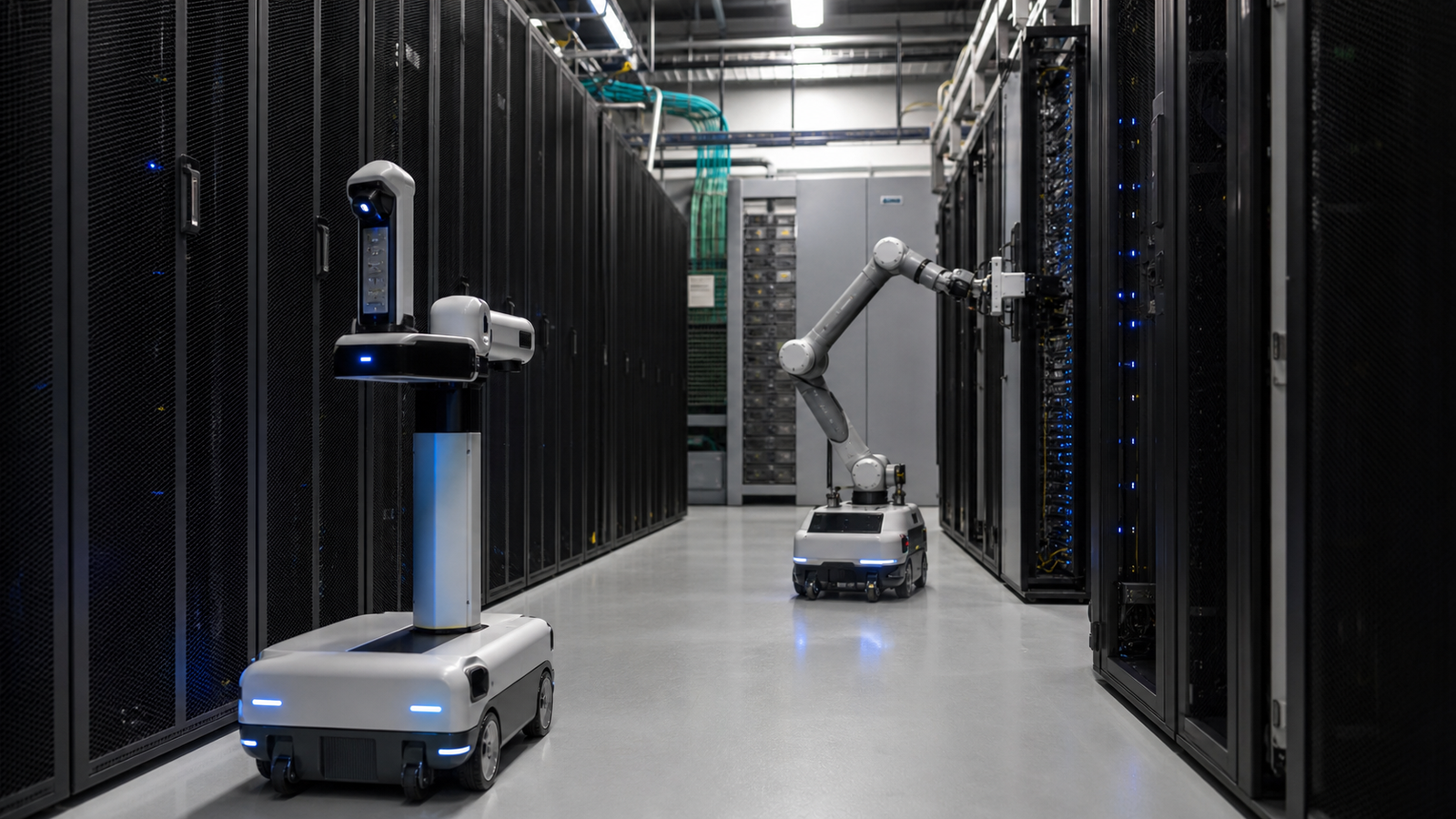
Meta is testing robots for the physical chores behind its AI infrastructure: pressing power buttons, swapping network cables, inspecting equipment, moving racks, and reseating components. The experiments are real, but the dramatic version—an autonomous robot replacing an entire data-center shift—is not the current capability.
The useful lesson for operations teams is not that humanoids have arrived. It is that a hyperscaler is decomposing physical maintenance into narrow tasks, then matching each task to the least complicated machine that can perform it safely.
The robot may be a finger, arm, or cart
WIRED reports several different experiments rather than one universal platform. A simple remote-controlled mechanism can press the power button on a device such as a Mac Mini. A Kinova Gen3 arm has been evaluated for power cycling or disconnecting servers. Other systems are being tested for network-cable work, inspection, rack movement, and repositioning components.
The hardware variety reflects the environment. A fixed arm can repeat a task within a known reach. A wheeled platform can move through aisles but must navigate doors, floor obstacles, and charging. A rack-moving machine handles weight without needing the dexterity required to release a small connector.
This is normal automation engineering. The question is not “Can a robot maintain a data center?” It is “Which high-frequency task has a stable enough workspace, clear success signal, and acceptable failure mode to automate first?”
Cables expose the gap between demos and production
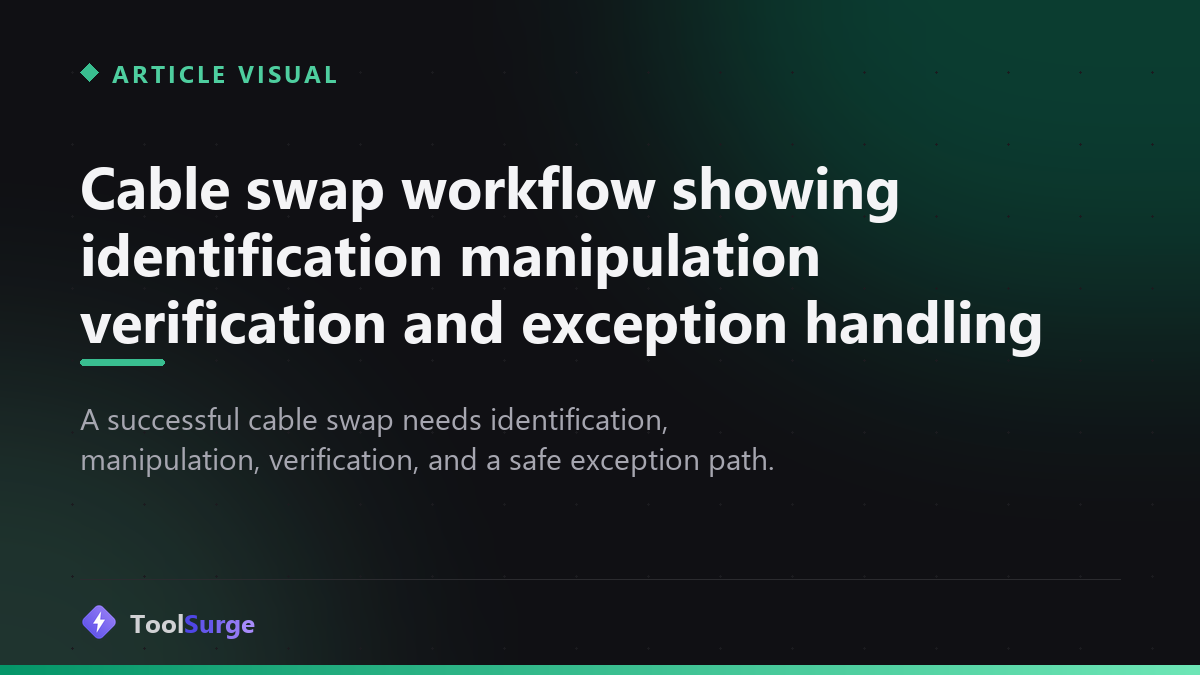
Network cables are flexible, visually similar, densely routed, and attached with small latches. A robot must identify the correct endpoint, reach it without disturbing neighbors, release it, confirm removal, route the replacement, seat it correctly, and verify the link.
Humans combine vision, touch, context, and improvisation during that sequence. A machine may perform the planned movement in a clean demonstration while struggling with a cable that bends differently, a label hidden behind another bundle, or a connector under unexpected tension.
Reports say current systems can be slower than workers, pause for charging, and require supervision. Some tasks around large numbers of cables for advanced AI systems were judged unsuitable for the tested machines. Those are not minor inconveniences; they determine whether automation reduces recovery time or introduces a second incident.
The operational target is therefore bounded. A robot can handle standardized actions while a technician owns exceptions, validation, and unsafe states. That resembles software agents in production: autonomy should expand after evidence, not before a control plane exists.
Labor impact is plausible but not a settled forecast
One unnamed worker estimated that a successful cable-swapping robot could replace up to 80 percent of some workloads. That is the worker’s estimate, not a Meta projection, a measured fleet result, or a promise that 80 percent of jobs disappear.
Workload and headcount are not identical. Removing repetitive resets may free technicians for diagnosis, deployment, safety, and exceptions. It can also reduce the number of people required for a particular shift. Both outcomes are possible, and company statements about hiring do not resolve the role-level effect.
Meta spokesperson Francis Brennan told WIRED that the company sees a shortage of skilled workers and is investing in people to build and operate data centers. At the same time, the scale of AI infrastructure gives Meta a strong incentive to automate repeatable labor and shorten incident response.
Teams evaluating similar systems should measure task time, intervention rate, error severity, coverage by site layout, and training burden. A successful pilot does not justify a staffing model until those measures hold across real conditions.
Physical robots meet Meta’s software agents
Meta has separately described AI agents that find and fix software efficiency problems across its infrastructure. Its Capacity Efficiency Program standardizes tools for profiling, experiment results, configuration history, code search, and documentation. The company says those systems can compress hours of investigation and recover large amounts of power.
Physical maintenance creates a possible second half of that loop. A software system detects a failed device, identifies a bounded action, and dispatches a robot under policy. The robot performs the action, sensors verify the result, and a human receives an escalation when confidence or safety conditions fail.
That architecture is more believable than a general robot wandering around deciding what to repair. It also demands strong identity and audit controls. A command that turns off the wrong server is a production change, whether issued by a person, agent, or arm.
The control plane should therefore know the asset, requested action, maintenance window, dependency risk, and expected verification signal. A robot needs a physical stop condition and a software authorization boundary. Cameras and force sensors can confirm motion, but the service itself must confirm that the correct machine returned to health.
Human supervision is not a temporary embarrassment. It is an operating mode that reveals which exceptions occur frequently enough to redesign. Teams should record why a technician intervened: blocked path, ambiguous label, unexpected resistance, stale inventory, low battery, or unsafe proximity. That ledger guides both model training and facility changes.
Our agent rollout guide explains the value of staged authority, and the LLM gateway postmortem shows why tail latency and failure handling matter after the happy path works.
What happens next
Watch for task-level production numbers: successful interventions, human assists, mean time to repair, damage incidents, and sites covered. Vendor announcements alone will not show whether the robots work in Meta’s densest environments.
Standardized racks, clearer labels, machine-readable port maps, and purpose-built fixtures may improve robots faster than a more general vision model. Automation often succeeds by changing the environment as well as the machine.
Procurement will be another gate. A fleet assembled from several robotics vendors needs common telemetry, patching, identity, and incident procedures. Otherwise each narrow labor-saving machine adds a separate operational island for technicians to support.
The winning system may look less like a humanoid coworker and more like a collection of boring, dependable tools. In infrastructure, repeatability is the feature that earns authority.
Quick poll
Which data-center task should robots handle first?
Reported trials show simple resets are easier than dense cable work.
FAQ
Is Meta replacing data-center workers with robots now? Meta is testing several systems. Public reporting does not establish a fleet-wide replacement program.
What can the robots do? Trials cover button presses, power cycling, cable work, inspection, rack movement, and component handling.
Why are cable swaps difficult? Cables are flexible, densely packed, visually similar, and require precise identification plus verification.
Are the robots autonomous? Capabilities vary. Reports describe supervision and human help for current systems, so “autonomous” should be evaluated per task.