Key Takeaways
- Nvidia will invest $3.5 billion in MediaTek through convertible bonds.
- MediaTek will use NVLink Fusion to help customers build custom XPUs for Nvidia-connected AI factories.
- The partnership also covers local AI PCs and automotive platforms.
- Nvidia is protecting its position by owning more of the interconnect and rack architecture around third-party chips.
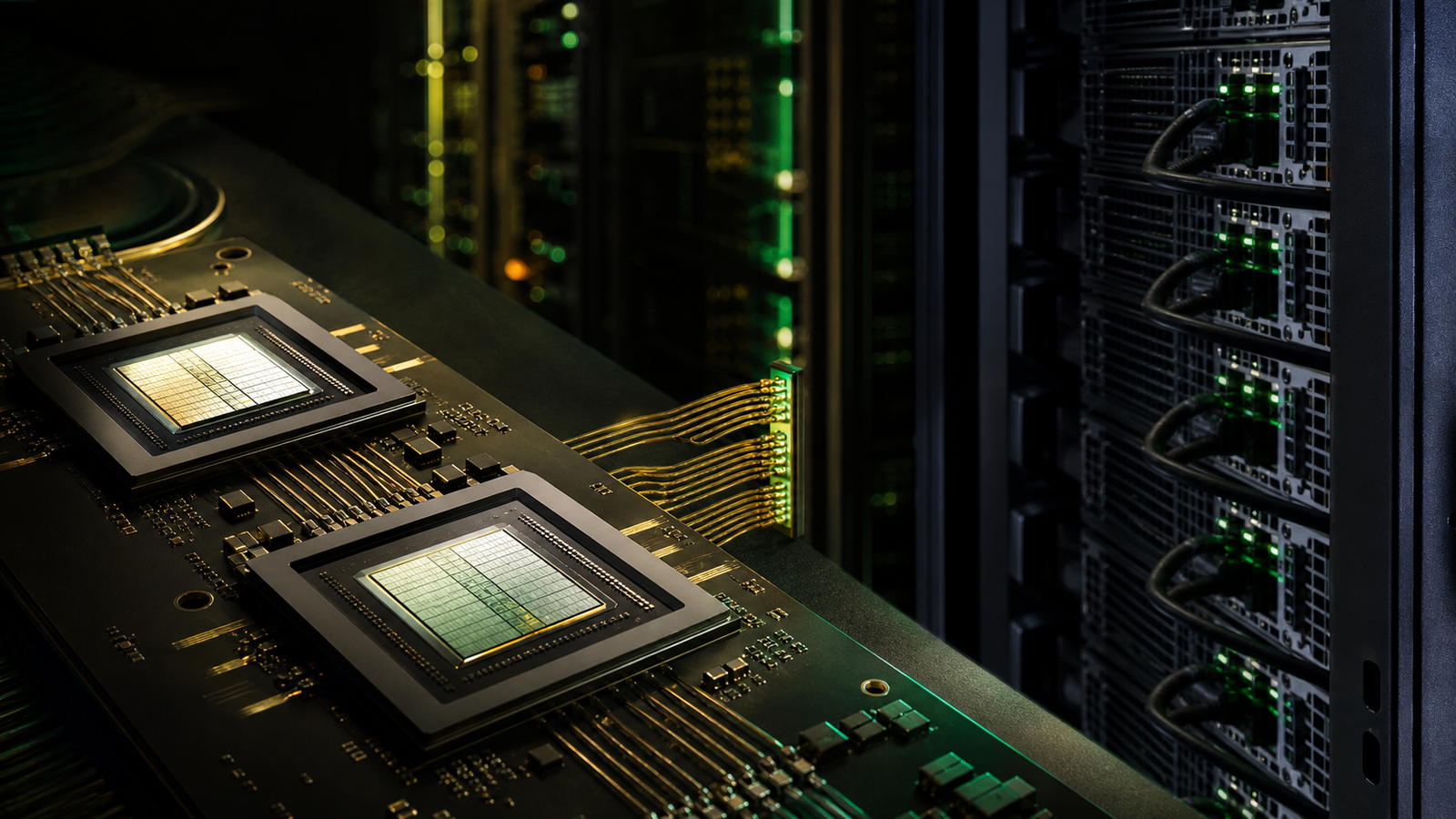
Nvidia is investing $3.5 billion in MediaTek convertible bonds while MediaTek adopts NVLink Fusion for custom AI accelerators. The deal lets cloud providers and model companies build more of their own silicon without necessarily leaving Nvidia’s rack-scale network, software and systems ecosystem.
The strategic move is easy to miss if the deal is read only as a chip investment. Nvidia is accepting that hyperscalers want custom accelerators. It is trying to make those accelerators more valuable when connected through Nvidia’s infrastructure.
What MediaTek brings
MediaTek is best known to many consumers for mobile and connectivity chips, but the company also has system-on-chip design, power-efficiency, advanced-packaging and custom-silicon experience. Those capabilities matter when a customer wants an accelerator tailored to one workload or cost target.
Under the expanded partnership, MediaTek can help customers create custom XPUs that enter NVLink-connected rack-scale systems. “XPU” is a broad label for accelerators or processors specialized beyond a conventional CPU.
The official announcement frames the path as prevalidated. That matters because a custom die is only one component. Memory, interconnect, packaging, power, cooling, system management and software determine whether it can operate at data-center scale.
MediaTek’s role gives customers a design partner; Nvidia’s role gives the resulting silicon a route into an established infrastructure stack.
Why Nvidia would help customers build alternatives
Amazon, Google, Microsoft and other large AI buyers are building custom chips to reduce cost, optimize workloads and limit dependence on merchant GPUs. Nvidia cannot prevent that trend by insisting every accelerator carry its logo.
It can instead make NVLink, rack systems and software the common layer. If a customer’s custom accelerator plugs into an Nvidia-connected environment, Nvidia retains influence and revenue around the chip.
This is the logic behind our article arguing that Nvidia’s moat moved beyond the GPU. The company increasingly sells an integrated computing platform: accelerators, interconnect, networking, systems and software.
The MediaTek deal makes that strategy financial as well as technical. The convertible-bond investment ties the companies together while MediaTek expands its data-center ambition.
What NVLink Fusion changes
NVLink Fusion opens Nvidia’s scale-up interconnect technology to custom CPUs and XPUs. A customer can design differentiated silicon while using Nvidia’s connectivity to communicate with GPUs and other components.
That reduces one barrier to custom acceleration: integration with the rest of the rack. It does not eliminate engineering. A custom XPU still needs compilers, kernels, memory planning, scheduling and workload proof.
Nvidia’s recent NVHBM work further targets memory bandwidth, die area and power. The technical blog claims improvements relative to standard HBM4e configurations, but actual benefit depends on the accelerator and system design.
The platform pitch is therefore “customize the compute, keep a known fabric.” Hyperscalers may accept that if it shortens development and preserves compatibility.
The investment is not an acquisition
Nvidia is buying convertible bonds, not announcing a full purchase of MediaTek. Convertible instruments can later turn into shares under defined conditions, but MediaTek remains a separate company.
The distinction matters because headlines about a multibillion-dollar investment can sound like control. The official announcement describes expanded collaboration across infrastructure, local computing and automotive.
Investors should also distinguish the $3.5 billion commitment from guaranteed revenue. Adoption, customer designs and production schedules determine commercial results.
For buyers, the deal does not mean every MediaTek product suddenly contains Nvidia technology. The scope is tied to specific collaborations and future platforms.
Local AI and automotive broaden the relationship
The companies already work on RTX Spark and DGX Spark PC chips that pair Nvidia GPUs with MediaTek SoCs. The announcement says that work will continue across consumer PCs, developer systems and enterprise workstations.
Automotive cooperation also continues around software-defined vehicles and physical AI. Vehicle platforms have long product cycles, certification needs and safety constraints that differ sharply from data centers.
The breadth gives the partnership more ways to create value, but analysts should avoid combining every segment into one forecast. A custom cloud accelerator, a PC SoC and an automotive platform have different customers and timelines.
What this means for AI infrastructure buyers
Customers gain another potential route to custom silicon that still works with Nvidia’s rack architecture. That can improve negotiating leverage and workload fit.
It can also deepen dependence on Nvidia’s interconnect and software. Replacing the accelerator later may be easier than replacing the fabric around it—or the reverse, depending on architecture.
Procurement teams should evaluate total switching cost. Ask which APIs, topology assumptions and management tools become specific to NVLink Fusion. Measure the custom XPU on real workloads, not only peak specifications.
Buyers can make that comparison concrete by testing one workload across the proposed XPU path and the existing GPU stack, including migration effort, developer time and failure recovery rather than quoting throughput alone.
Our review of multi-GPU kernel benchmarks shows why accelerator claims must be scoped to tasks. A faster component does not automatically improve an end-to-end application if communication or software becomes the bottleneck.
What could go wrong
Custom-chip programs are expensive and slow. Requirements can change before silicon arrives. Volume may fail to justify non-recurring engineering cost. Software teams may not be ready to exploit the hardware.
The partnership also has to manage incentives. Nvidia benefits from a broad ecosystem, but its own GPUs can compete with some custom accelerators. MediaTek needs enough design freedom to create meaningful differentiation.
Regulatory review, export controls and Taiwan-related supply risk remain part of the environment. The announcement does not remove those external constraints.
What happens next
Watch for named hyperscaler designs, tape-out timelines, production systems and measured interoperability. A press release proves commitment, not deployment.
The most important signal will be whether customers choose MediaTek-designed XPUs because NVLink shortens the path to a working rack. If they do, Nvidia can lose some GPU share in a system while keeping the system inside its ecosystem.
That is the bet behind the $3.5 billion: custom silicon is coming, so make the surrounding platform harder to replace.
Developers will experience the strategy through tools long before they buy a rack. Compiler support, profiling, kernel libraries and deployment abstractions determine whether a custom XPU feels like another target or an entirely separate platform. Nvidia and MediaTek must show that the promised prevalidated path reaches software teams, not only system architects. A design win without usable tooling can preserve ecosystem headlines while leaving workloads on existing GPUs.
Power, cooling and availability will remain purchase gates even when compatibility is proven. Rack economics decide whether architectural flexibility becomes production volume.
Quick poll
What matters most in a custom AI chip?
MediaTek will design custom XPUs for an NVLink-connected rack ecosystem; production results remain to be proven.
FAQ
How much is Nvidia investing in MediaTek? $3.5 billion through convertible bonds.
Is Nvidia buying MediaTek? No acquisition was announced. The investment deepens a partnership between separate companies.
What is NVLink Fusion? It is Nvidia’s platform for connecting custom CPUs and XPUs into NVLink-based AI infrastructure.
Why would Nvidia support custom chips? Because customers are building them anyway; Nvidia can retain value through interconnect, systems and software.