Key Takeaways
- Caterpillar reported more than 1.6 million connected and reporting assets in its 2025 highlights.
- Cat AI Assistant helps operators and technicians find procedures, troubleshoot, and identify parts.
- The company is applying mining automation lessons to construction sites, quarries, manufacturing, and internal work.
- Caterpillar plans $100 million in training over five years for 118,000 employees, according to TechCrunch's report.
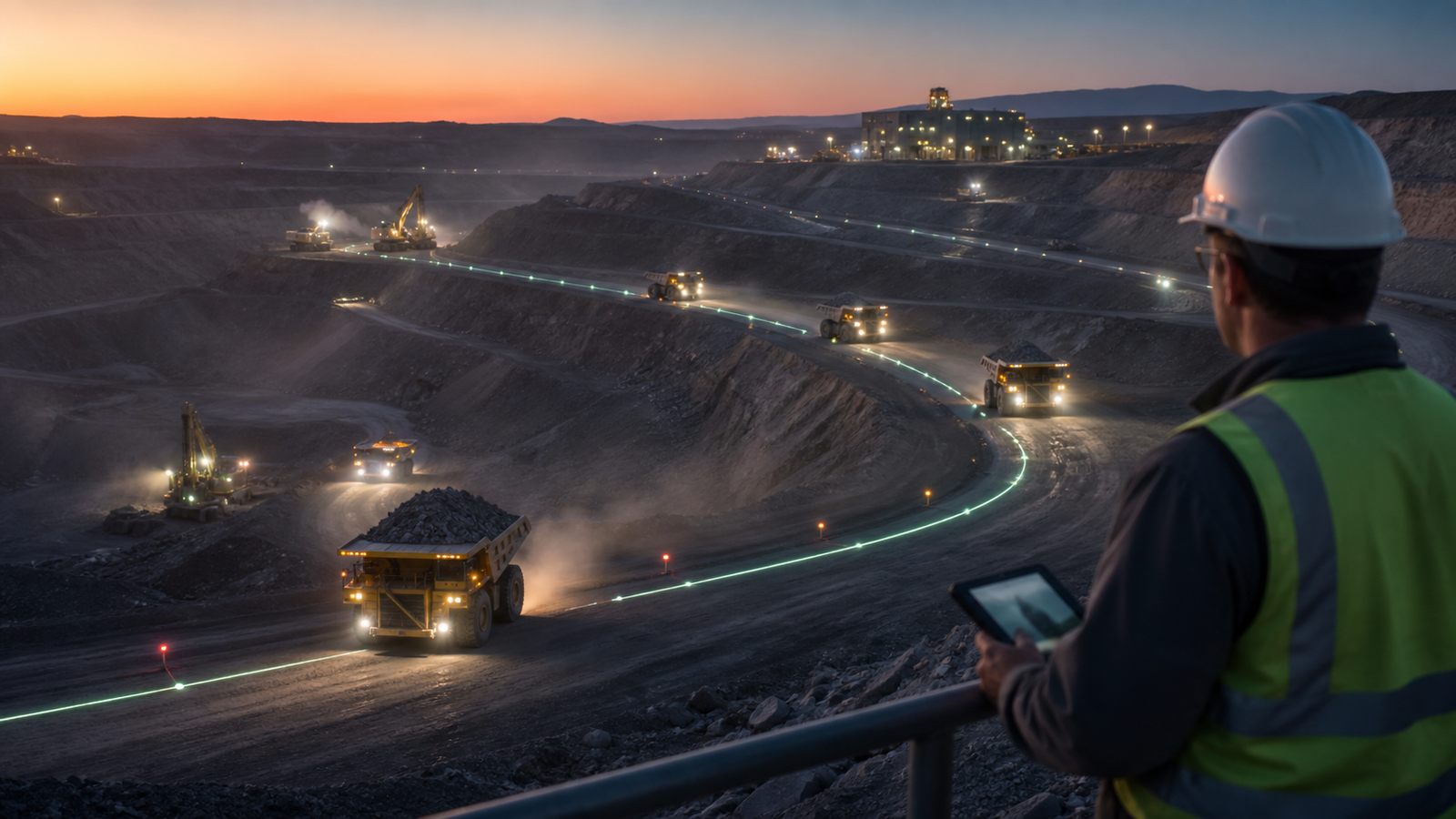
Caterpillar’s AI strategy is not beginning with a chatbot pasted onto a generic knowledge base. It begins with decades of autonomous mining work, more than 1.6 million connected and reporting assets, and service data tied to machines that fail in expensive physical environments.
The playbook matters beyond heavy equipment because it starts with workflow integration. A model is useful only when its answer reaches the person, machine, and decision point where work actually happens.
Mining forced the hard integration questions early
Autonomous mining is a demanding starting point. Haul trucks and drills operate around people, large equipment, changing terrain, dust, weather, and production targets. A mistake is not a malformed paragraph; it can stop a site or create a safety hazard.
Caterpillar built autonomy alongside command centers, fleet management, remote control, and terrain intelligence. That stack teaches several durable lessons: sensors need maintenance, local conditions matter, operators need clear overrides, and value comes from coordinated fleet behavior rather than one impressive machine.
Chief technology officer Jaime Mineart told TechCrunch that Caterpillar now wants to bring those lessons into more dynamic environments such as construction sites and quarries. Those environments may be smaller than a mine but less standardized, with more equipment types and temporary layouts.
The proprietary data is useful because it has context
Caterpillar says its connected fleet exceeded 1.6 million reporting assets in 2025. TechCrunch reports more than 16 petabytes of structured data. Scale is important, but context is the defensible part.
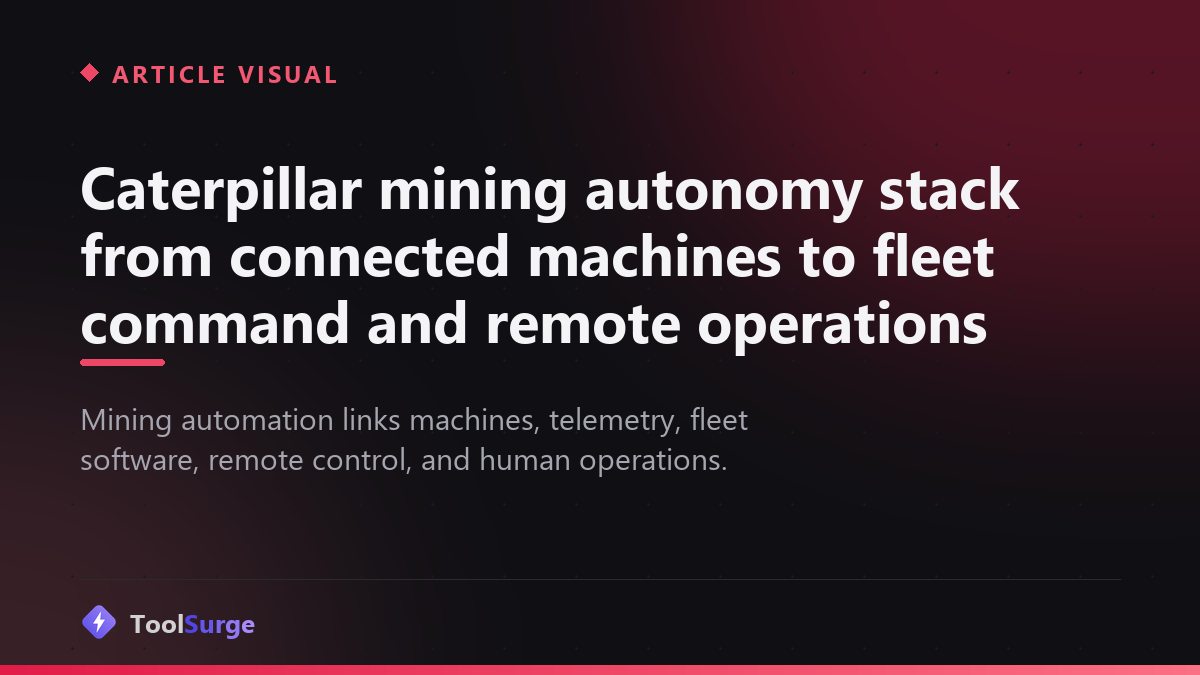
A service record can connect a model, serial range, operating condition, fault code, procedure, part, and outcome. Machine telemetry can show what happened before a failure. Dealer and technician workflows add information about what actually fixed it.
That is more valuable than dumping manuals into a vector database and calling the result expertise. An industrial assistant must distinguish similar machines, respect safety procedures, and know when the available evidence does not identify one correct action.
Cat AI Assistant is a visible example. Operators and technicians can use voice to find repair procedures, troubleshoot potential problems, and identify needed parts while near a machine. The interface reduces search friction, but its business value depends on accurate model matching and a handoff to the real service process.
Training the workforce is part of deployment
Caterpillar’s reported plan to spend $100 million over five years training 118,000 employees in AI, autonomy, and robotics acknowledges a common failure mode. Buying tools without changing work creates pilots that never reach the field.
Training should not mean asking every employee to become a prompt engineer. A technician needs to know which recommendations are advisory, how to confirm machine identity, where sources appear, and how to report a wrong answer. A manager needs to know whether time saved is moving to higher-value work or merely hiding rework.
The company also has a dealer network, which complicates rollout. Dealers vary in systems, local inventory, customer mix, and connectivity. A central model must fit those operational differences without turning every exception into a one-off integration.
Connectivity is not guaranteed at every jobsite. A field tool must define what works offline, how recently its procedures were synchronized, and what happens when machine telemetry is incomplete. The safest answer may be to stop and escalate rather than fill a gap with a plausible recommendation. Industrial trust grows when the system exposes its evidence boundary.
Localization matters too. Procedure terminology, parts availability, regulations, and dealer practice can vary by market. Translating an interface is easier than validating that the underlying instruction applies to the exact machine configuration in that country.
This is where governance becomes practical. Access control, audit logs, data boundaries, offline behavior, and escalation paths determine whether a tool can move from an innovation group to thousands of service interactions.
What other companies can copy
Start with a costly, repeated decision and the evidence needed to make it. Map systems, people, and physical consequences before choosing a model. Keep machine or customer identity attached to retrieved knowledge. Measure the complete workflow, including verification and rework.
Use narrow tools first. A procedure finder with citations is easier to validate than an agent authorized to order parts and shut down equipment. Add action only after the recommendation stage has reliable evidence and a safe exception route.
Establish a baseline before rollout. Measure how long technicians currently spend finding documentation, how often the first diagnosis is right, and where parts identification fails. Without that baseline, a faster-looking assistant can create unmeasured rework. Sample high-risk cases separately from routine ones, because average accuracy can hide the mistakes that matter most.
Finally, treat connected assets as an ongoing learning system. Capture whether a recommendation worked, under what conditions, and who overrode it. Without outcome data, the assistant repeats documentation rather than improving operations.
Our Figma and Uber agent rollout guide uses the same staged-authority principle in software, while Stripe’s billing-agent rule shows why sandbox success cannot authorize production action.
What happens next
The strongest evidence will be task-level results: repair time, first-time fix rate, downtime avoided, safety incidents, and adoption across dealers and sites. Connected-asset count and data volume describe potential, not realized value.
Caterpillar also must show that lessons from structured mines transfer to less predictable construction environments. The company has a credible starting point because it owns machines, software, service relationships, and historical data. It still has to prove each new workflow.
The most convincing proof will be repeatable improvement across dealers rather than one showcase site. That is where proprietary data, training, and operational integration either become a compounding advantage or an expensive collection of disconnected pilots.
Public case studies should name the machine class, workflow, baseline, review period, and failure boundary. Those details let customers distinguish a durable operating improvement from a carefully selected demonstration.
Quick poll
Where would industrial AI create the fastest value?
Caterpillar's visible assistant begins with procedures, faults, and parts around connected equipment.
FAQ
What is Cat AI Assistant? It is an AI-enabled tool designed to help operators, technicians, and fleet managers find procedures, troubleshoot, and identify parts.
How many connected assets does Caterpillar have? The company reported more than 1.6 million connected and reporting assets in its 2025 highlights.
Is Caterpillar using fully autonomous construction sites? The company sells mature mining autonomy and is extending lessons into more dynamic settings. Capability varies by machine and workflow.
Why does employee training matter? Industrial AI changes decisions with physical and safety consequences, so users need role-specific validation and escalation practices.