Key Takeaways
- OpenAI said on August 28 that it notified SpaceX of its intent to wind down the contract supplying OpenAI models to Cursor.
- OpenAI described November 12, 2026 as the proposed shutoff date and said it was giving the maximum notice allowed by the contract.
- Cursor confirmed on August 14 that SpaceX had acquired it and said the deal would expand its compute access and in-house model work.
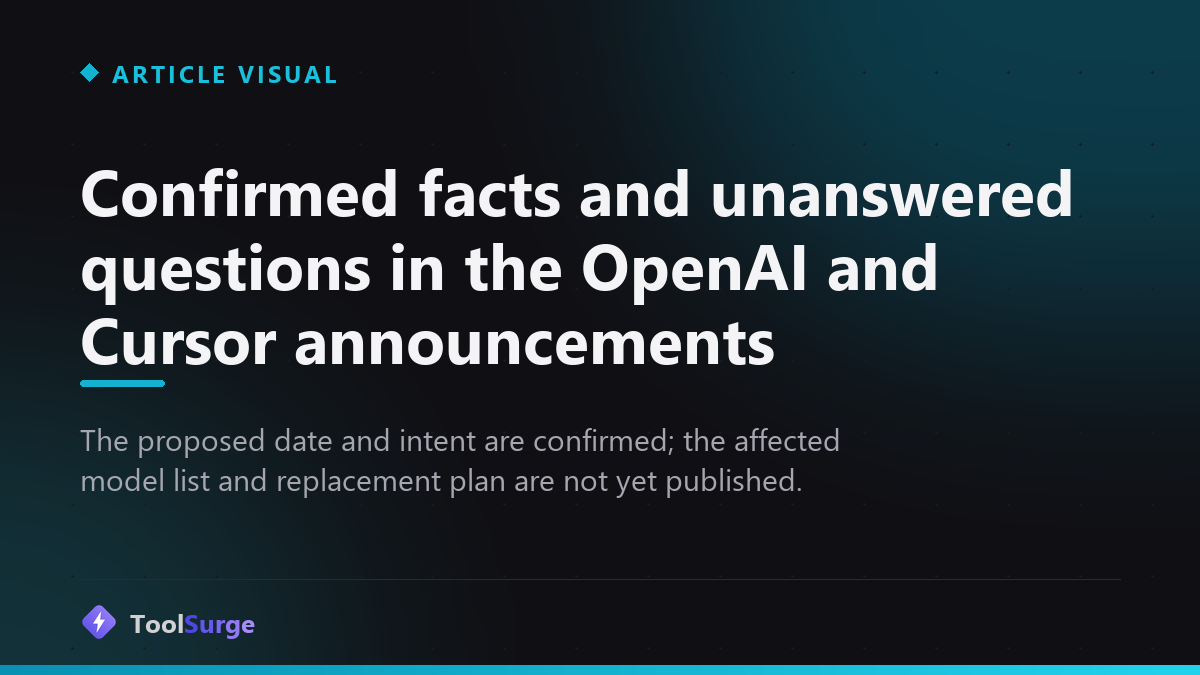
- Neither announcement names every affected Cursor model, promises a replacement, or says that the Cursor editor or its own models will stop working.
OpenAI says it intends to wind down the contract that provides its models to Cursor, with a proposed shutoff date of November 12, 2026. The move follows Cursor’s acquisition by SpaceX, which Cursor confirmed on August 14. It does not mean Cursor itself is shutting down, and neither company has published a model-by-model transition plan for users.
That distinction matters. The confirmed event is a planned supplier change inside a coding product, not the disappearance of the product.
What the two companies actually announced
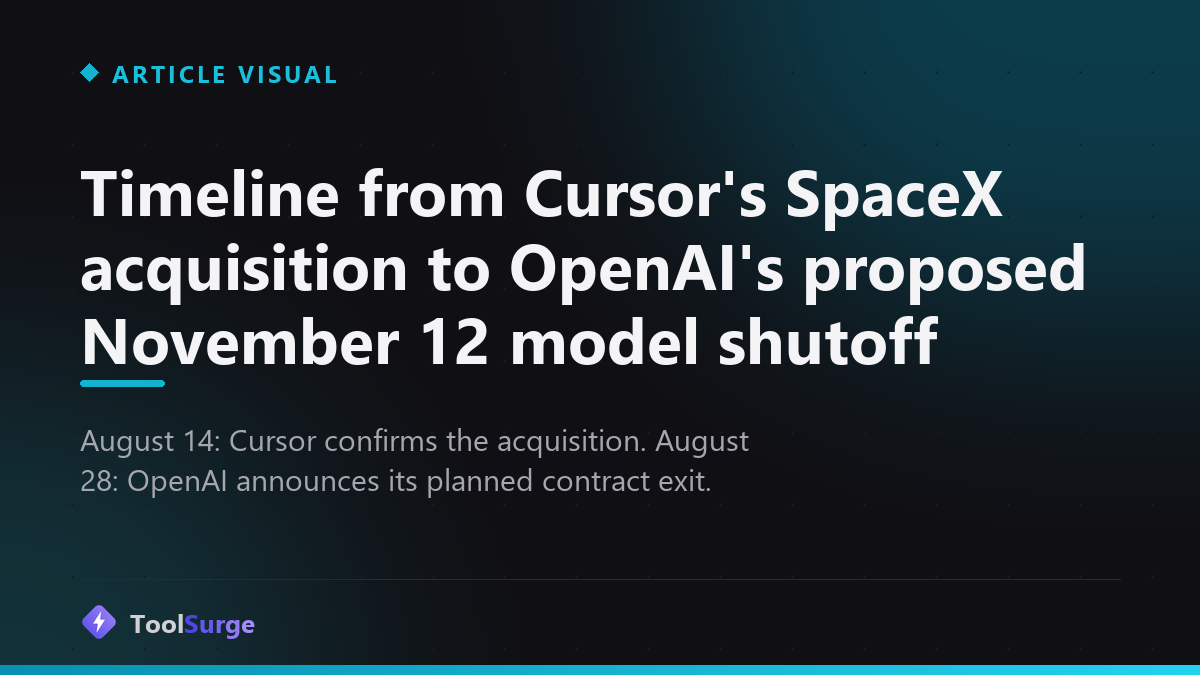
Cursor’s statement came first. On August 14, the company said it had officially been acquired by SpaceX, completing a process that began with an April model-training partnership. Cursor framed the deal around compute: it said access to SpaceX’s GPU fleet would help it build stronger models that cost less to run, and pointed to Grok 4.6 as an early example of what the combined teams could produce.
OpenAI responded two weeks later. In an August 28 statement, it said it had notified SpaceX that it intended to wind down the agreement under which OpenAI models are provided to Cursor. OpenAI called November 12 its proposed shutoff date and said it chose the latest date available under the contract so developers could keep access for as long as possible.
OpenAI also said it would not provide future models to Cursor. That is the clearest forward-looking product consequence in either statement. It still leaves important questions unanswered: which current model entries remain available until November 12, what happens to saved configurations, and whether any model will leave earlier. The companies had not answered those questions in the two announcements reviewed for this article.
OpenAI’s rationale is OpenAI’s allegation
OpenAI said it made the decision because it could not be confident that SpaceX would use OpenAI technology within its terms. Its statement referred to what OpenAI described as prior contract violations by companies controlled by Elon Musk and said the Cursor agreement gave OpenAI a limited cancellation window following a change of control.
Those are OpenAI’s stated allegations and contractual rationale. Cursor’s acquisition announcement does not address them. We should not convert one party’s account of a contract dispute into an independently established finding.
OpenAI also connected the decision to its responsibility for future, more capable models, including a model it calls Astra. Again, the statement does not say Astra had been promised to Cursor or give a release date. The supported conclusion is narrower: OpenAI says future models will not be supplied under this Cursor agreement.
This sourcing discipline is especially important because Cursor is already one of the most compared coding tools. Our existing Cursor review covers its day-to-day product experience. The new event is about model supply and ownership, not a fresh verdict on whether the editor is good.
What Cursor users should audit now
Start by identifying where an OpenAI model is a dependency rather than guessing from the Cursor logo. Check model selections in team settings, project instructions, saved workflows, screenshots used for training, and any evaluation fixture that expects a particular model name or behavior. Record the task, current model, and acceptance check.
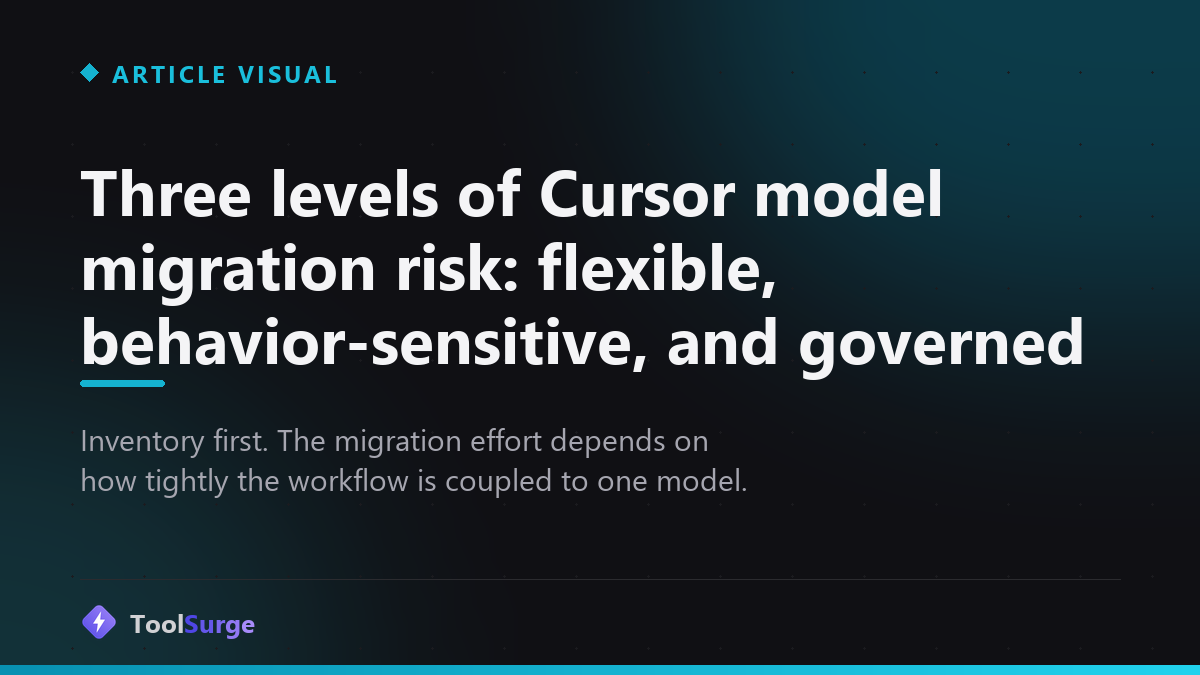
Then separate three kinds of work:
- Model-flexible tasks where any approved model can pass a simple test.
- Behavior-sensitive tasks where prompts, tools, or output parsing depend on one model’s habits.
- Regulated or customer-bound tasks where changing a model requires review, disclosure, or a new risk assessment.
The first group may need only a replacement and smoke test. The second needs a side-by-side replay on representative repository work. The third needs an owner and an explicit decision before the supplier changes. A generic benchmark cannot tell you whether a replacement respects your test conventions, edits the right files, or stays inside your permission boundary.
If you are deciding whether to move tools rather than models, our Cursor versus Claude Code versus Copilot guide lays out the broader product trade-offs. Do not make that larger decision solely from this contract notice. November 12 leaves time to test, and Cursor’s own models and other integrations are a separate question.
What the SpaceX acquisition may change — and what it does not prove
Cursor says the acquisition gives it access to a very large GPU fleet and should help it deliver more capable, economical models. It also describes Cursor as one place where SpaceX’s intelligence infrastructure becomes useful. Those are the acquired company’s expectations, not measured post-acquisition results.
It is reasonable to expect Cursor to emphasize models developed with SpaceX resources, because Cursor itself points to Grok 4.6 as an early look. It is not reasonable to claim that every OpenAI model will be replaced feature-for-feature, that prices will fall, or that output quality will improve. Neither statement provides those guarantees.
The practical comparison should therefore wait for a named replacement, its availability, and repeatable task results. A model picker can make two providers look interchangeable even when their tool use, latency, context handling, or refusal behavior differs. Teams should compare completed work, not branding.
What happens next
The next useful update is not another corporate statement. It is a support document that lists affected models, dates, replacements, plan eligibility, and whether saved model choices migrate automatically. Until Cursor or OpenAI publishes that detail, November 12 should be treated as a planning deadline rather than a promise about each user’s interface.
OpenAI said it was willing to support developers through the transition, but its announcement did not describe that support. Cursor’s statement predates OpenAI’s decision and therefore offers no migration instructions. Watch both companies’ official documentation, and capture the configuration you rely on before changing it.
Our best AI coding assistants guide remains useful for product selection, but this event adds a new question to every comparison: who controls the model supply, and how quickly can that supply change after an acquisition?
Quick poll
What would you do if your preferred model leaves Cursor?
OpenAI calls November 12 a proposed shutoff date; neither company has published a complete affected-model list.
FAQ
Is Cursor shutting down on November 12, 2026? No. OpenAI says it plans to stop supplying its models under its Cursor contract. Cursor itself, its editor, and non-OpenAI models are not described as shutting down.
Will every OpenAI model disappear from Cursor on November 12? The announcement does not provide a model-by-model list. November 12 is OpenAI’s proposed contract shutoff date, so users should wait for detailed product documentation before assuming how every picker entry will behave.
Why is OpenAI ending the agreement? OpenAI says the SpaceX acquisition triggered a contract window and that it has concerns about compliance with its terms. Those concerns are OpenAI’s stated rationale; Cursor’s acquisition post does not address them.
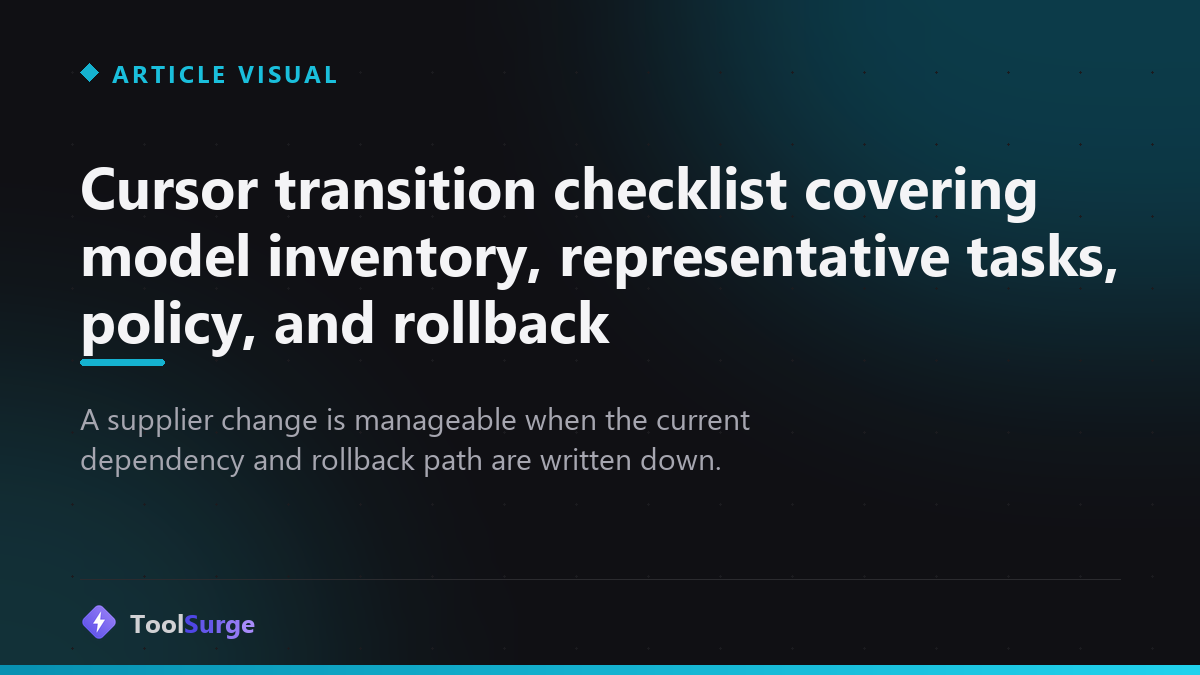
What should a team do first? Inventory workflows pinned to an OpenAI model, choose representative tasks, and record acceptance criteria and a rollback option. Do that before replacing the model or the coding product.